
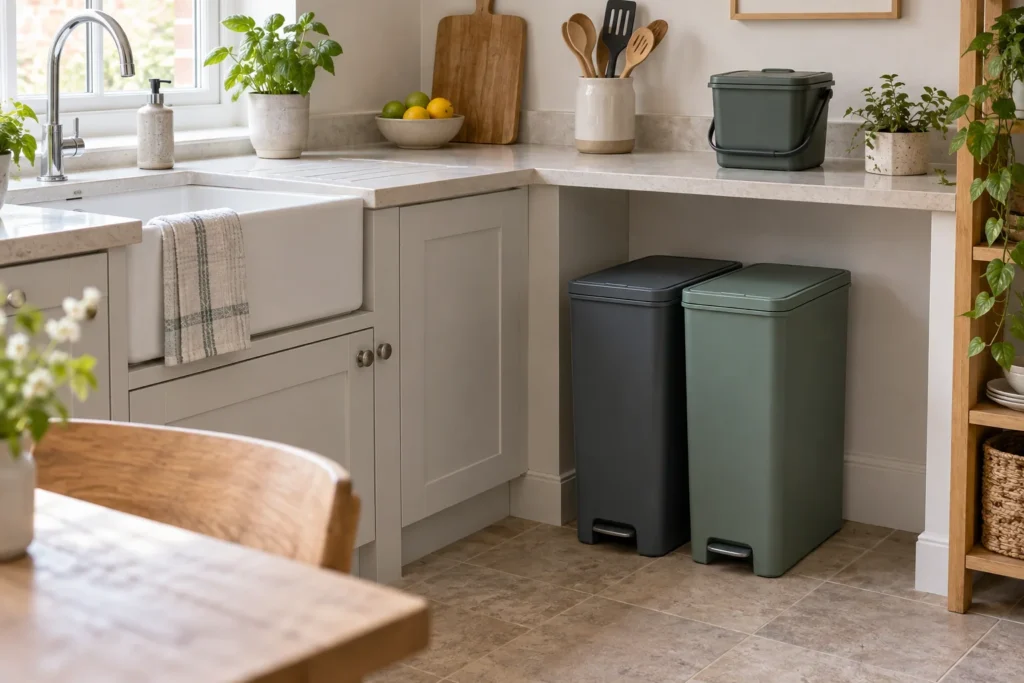
Kitchen recycling storage works when the compartments correspond to the collection system outside your home. A stylish three-section bin may be convenient, but its categories are not a substitute for your council’s instructions. Start with the local service, then choose the capacity and layout that support it.
Image: AI-generated editorial illustration of generic equipment; not a photograph of a reviewed product.
Table of Contents
Find the current local instructions
Use the GOV.UK council finder to reach your council’s website. Its waste and recycling pages should be your reference for accepted materials, separation, containers and collection arrangements. GOV.UK’s household-waste guidance also directs residents to local collection and recycling-centre information.
Record the instructions that apply to your address rather than copying a neighbouring area’s system. If you live in a building with communal bins, check the property’s actual arrangement as well. Keep any collection calendar accessible to everyone who takes waste out.
Observe a normal week’s packaging
Notice which materials take the most space and how often you carry them outside. The largest internal compartment should reflect that routine, not simply the equal divisions offered by a bin. A household receiving many deliveries may have a different space problem from one mainly dealing with food packaging.
Do not keep every material in the kitchen if another appropriate location makes more sense. A clearly defined place for cardboard, for example, may help if it fits the home’s access and collection arrangements. Preserve safe movement through the room rather than allowing a temporary pile to become a permanent obstruction.
Measure the whole bin movement
Record the floor or cupboard footprint, lid-opening height and the space needed to remove an inner bucket or bag. A bin can fit under a counter while its lid cannot open properly. A pull-out can fit a cupboard but still obstruct the walkway when extended.
Check the maker’s installation, load and liner instructions. If a unit attaches to a cupboard door, establish that the door and fixings suit the product before installing it. Do not infer compatibility from cabinet width alone.
Label compartments in local language
Use the council’s categories and examples rather than a generic recycling symbol on every section. Labels should be readable where a person stands to dispose of an item. If colour is used, support it with text so the system does not depend on colour recognition alone.
Keep unusual items out of an uncertain compartment until the correct route is established. A wish that something ought to be recyclable is not evidence that the local collection accepts it. Make the council’s lookup information easy to find for those occasional decisions.
Include carrying and cleaning
| Stage | Planning check |
|---|---|
| Sorting indoors | Categories match local instructions |
| Opening the bin | Lid or pull-out clears the surrounding space |
| Emptying | Inner container can be lifted and carried comfortably |
| Cleaning | Base, lid and removable parts are accessible |
For example, a large inner bucket may reduce emptying frequency but become awkward to carry through a narrow doorway. Compare the actual route to the outside bins. Several manageable trips may fit your household better than a container chosen solely for maximum litres.
Map a changing collection day
Consider a week when a collection moves because of a bank holiday. Your indoor layout still needs to connect with the council’s actual collection instructions and whatever temporary holding arrangement is permitted. Keep the official collection information accessible instead of relying on a handwritten rule that nobody updates. Label the indoor compartments by the accepted stream, then decide who checks collection changes and moves material outside. This is an organisation role, not a reason to invent extra collection capacity. If a particular stream regularly exceeds the space available, review purchasing and the council’s options before adding another indoor bin blindly.
Choose compartments after the plan
Our kitchen bin guide covers wider product choices. Use your local categories, available space and carrying routine to narrow that selection. A useful recycling station makes the correct local action clear and leaves the kitchen easy to move through and clean.