
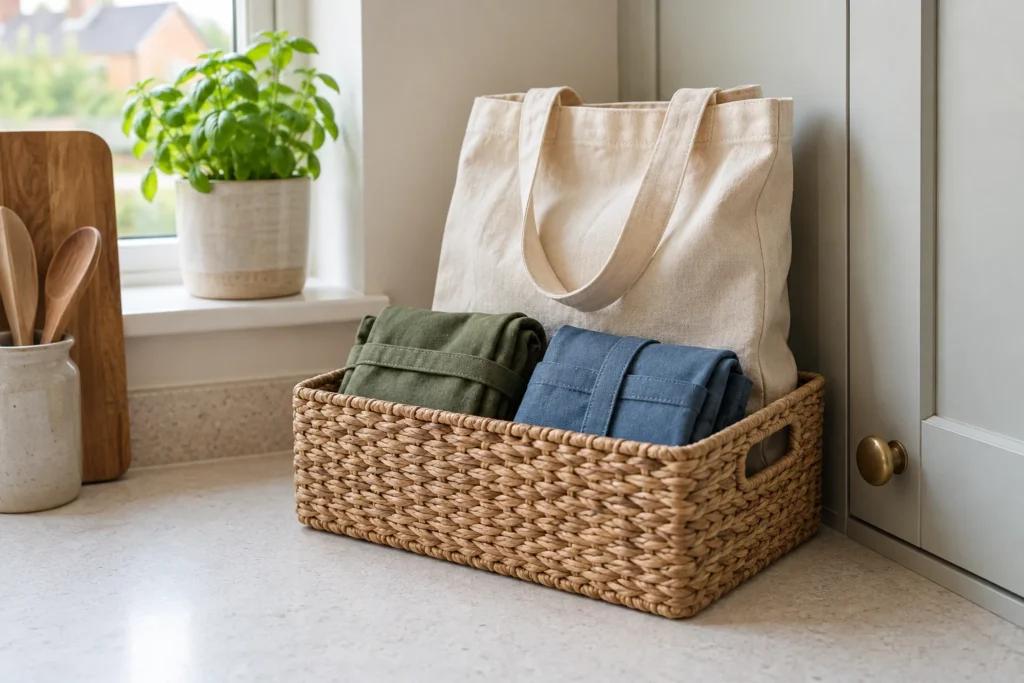
Reusable shopping bags are useful only when the right bags are ready for the next trip. A cupboard full of folded bags does not help if they are difficult to retrieve or still need cleaning after the previous shop. Build a short return routine around unpacking, checking and storing the working collection.
Image: AI-generated editorial illustration of generic equipment; not a photograph of a reviewed product.
Table of Contents
Decide which bags have which role
Separate the bags used for different kinds of shopping and make those roles understandable. The FSA’s cross-contamination guidance recommends keeping bags for raw meat, fish and poultry separate from those used for other foods and checking reusable bags for spills or damage.
Use a clear identifier where helpful, following the bag’s care and labelling instructions. Do not rely on somebody remembering that a particular unmarked bag was used for raw food last week. Keep food-shopping bags distinct from bags used for household chemicals or unrelated dirty items.
Make checking part of unpacking
After the shopping is put away, examine the bags before folding them into storage. Follow the manufacturer’s cleaning instructions and the relevant official food-hygiene advice for the material and previous use. A bag that needs attention should have a clear place outside the ready-to-use group.
Do not hide a damp or soiled bag inside another simply to clear the worktop. The return process is complete when the bag has been dealt with appropriately and can be identified as ready for its next intended use.
Count the working collection
Estimate how many bags you normally take for a routine shop, including the formats needed for different items. Keep those accessible. Occasional large bags or spares can have a separate home rather than filling the front of the daily storage area.
Avoid using a large container as a reason to keep adding bags indefinitely. A defined storage boundary makes the collection easier to review. If a bag no longer serves a useful role, check its condition and the appropriate reuse or disposal options rather than returning it to an overflowing pile.
Choose a storage shape that suits the bags
Soft bags can be folded according to their construction; structured bags may be more convenient stored upright or nested in a supported arrangement. Check handles and rigid inserts rather than forcing every style into the same compact bundle.
Measure the cupboard or drawer before buying a holder. IKEA’s kitchen interior-fittings guide includes a bag-dispenser format, but a holder’s suitability still depends on your actual reusable bags and its instructions. A design for thin bags may not suit a thick structured shopper.
Put the reminder at the departure point
| Stage | Simple household action |
|---|---|
| Unpack | Keep bag-use groups identifiable |
| Check | Look for spills, damage and needed care |
| Store | Separate ready bags from those awaiting attention |
| Leave for shopping | Retrieve the planned working set |
Choose a reminder that fits how you leave home: a note with the shopping list, a clear bag position near the appropriate exit, or another reliable household cue. Keep the location safe and unobstructed. The aim is to remember the bags without turning the hallway into another storage problem.
Close the loop after unpacking
Choose one person or one visible reminder to return the ready bags to their departure point after the shop. Without that final step, clean folded bags may accumulate in a cupboard while the household repeatedly buys more at the checkout. Keep special-purpose bags identifiable and do not fold a damp or dirty bag into the ready stack. If the bags travel between two cars or several people, agree which set belongs where. A small routine attached to unpacking is easier to sustain than periodically sorting a large mixed collection when it has already become inconvenient.
Keep the routine easy to repeat
Trial the system over a few normal shopping trips and adjust the point where bags are repeatedly forgotten or mixed. Our kitchen storage guide offers wider cupboard ideas. A useful bag arrangement preserves clear roles and makes the ready collection easy to take and return.