
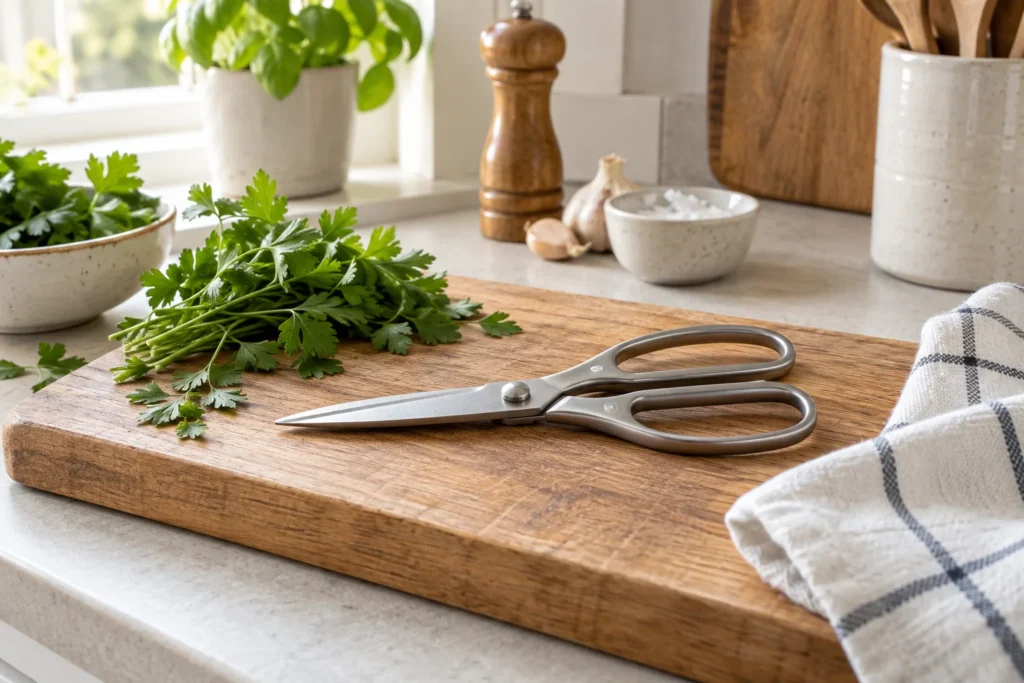
Kitchen scissors combine a grip, pivot and two blades, so their usefulness depends on more than whether they cut a test piece of paper. For food preparation, check the manufacturer’s intended tasks and how the joint can be cleaned. Utility scissors from another part of the home are not automatically a suitable substitute.
Image: AI-generated editorial illustration of generic equipment; not a photograph of a reviewed product.
Table of Contents
Choose the food task first
List what you want the scissors to do: snip herbs, open suitable food packaging or perform another task expressly supported by the manufacturer. A pair designed for one role should not be assumed suitable for tougher materials simply because its blades look substantial.
Keep packaging and food-contact work within an appropriate cleaning routine. If a pair is used on non-food household materials, do not move it straight into food preparation without establishing that the tool and cleaning method are suitable. Giving kitchen scissors a dedicated home helps preserve their intended role.
Understand what detachable blades add
OXO’s Kitchen and Herb Scissors have micro-serrated blades that separate for cleaning, along with cushioned handle pads and a herb-stripping feature. The detachable design is a specific example of access to the joint; it does not mean every pair with a central pivot comes apart.
Find the manufacturer’s method for separating and reconnecting the exact scissors. Some designs use a particular opening position or release arrangement. Do not remove a screw or force a joint simply because another model detaches easily.
Check the handles and opening movement
Compare the size and shape of the finger openings and any left- or right-handed specification. Consider the hand movement required through the intended cutting task, not just the appearance of the closed handles. A return spring, loop shape or cushioned pad can change the design without guaranteeing comfort for every person.
Where possible, examine a suitable sample in a controlled retail setting. If buying remotely, ask for handle dimensions when photographs do not provide enough information. Avoid treating a general comfort claim as evidence that the scissors suit a particular hand or access need.
Plan cleaning before storage
Follow the model’s care instructions for blade surfaces, the pivot and any removable parts. Clean only after the scissors are positioned as directed and keep the sharp edges visible and controlled. A dishwasher symbol for one product does not establish permission for another pair with a different handle or joint.
Check that the parts can dry before reassembly or storage, following the maker’s sequence. A design with an extra herb stripper, notch or opener may offer another function while also adding recesses to inspect. Count those features as useful only if you expect to use and maintain them.
| Feature | Question to answer |
|---|---|
| Intended tasks | Does the maker support the food preparation you need? |
| Handle openings | Are size, shape and handedness suitable? |
| Detachable blades | Is the removal and reassembly method documented? |
| Pivot access | Can the joint be cleaned as instructed? |
| Storage | Can the closed tool be kept in a clear, suitable position? |
Inspect the reassembly step before purchasing
With detachable scissors, find out how the blades reconnect and how you confirm that the joint is properly engaged. A cleaning advantage is useful only if the household can reliably rebuild the tool before its next food task. Keep any protective cover with the scissors rather than storing it in a separate drawer where it may be forgotten. If several people use the kitchen, show them the maker’s intended assembly movement. Do not assume that a familiar-looking pivot behaves like another pair of scissors, especially when the blades release only at a particular position.
Inspect the complete tool over time
If the blades no longer align, the joint becomes loose or a handle is damaged, consult the maker’s service or replacement guidance. Repeatedly tightening an unspecified fitting or using more force is not a reliable maintenance method. Keep the model details so replacement parts, if offered, can be identified accurately.
Our knife-set guide covers the wider cutting-tool collection. Kitchen scissors deserve their own fit and cleaning assessment, especially when they are expected to handle food. A clear purpose and accessible joint matter more than a long list of secondary functions.