
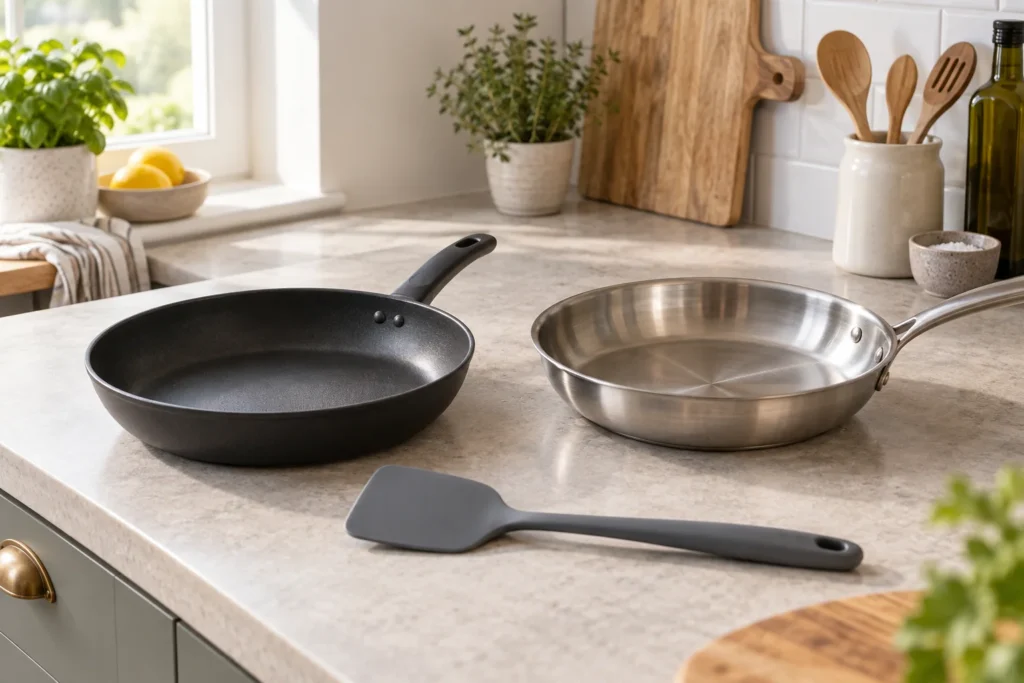
The useful comparison is usually between an uncoated stainless-steel cooking surface and a non-stick cooking surface. “Stainless steel” alone describes a material, and a steel-bodied pan can also have a coating. Identify what food actually touches before deciding which routine suits the meals you cook.
Image: AI-generated editorial illustration of generic equipment; not a photograph of a reviewed product.
Table of Contents
Separate surface from body construction
All-Clad Pro Nonstick constructions includes non-stick options built on layered stainless-steel constructions. That is a direct example of the labels overlapping rather than being opposites. Check the interior specification, then read the body and base information separately.
For an uncoated steel candidate, confirm that the cooking surface is actually uncoated. For a coated candidate, identify the range and its care instructions. A silver exterior or a dark interior is not enough to supply the complete specification.
Start with your recurring recipes
List the foods and methods you use most often, including any recipe that specifies a particular pan. Think about whether you value easy release, a pan-sauce stage, a particular shape or the ability to follow a familiar cleaning routine. These priorities can lead to a mixed collection rather than one surface for every job.
| Your priority | Comparison to make |
|---|---|
| A familiar delicate-food routine | Check the recipe's surface and heat guidance |
| A method that develops material on the pan for a sauce | Confirm the recipe and cookware permit the intended steps |
| Straightforward everyday washing | Compare the exact approved care routines |
| Hob-to-oven cooking | Check the complete assembly's oven permission |
| One shared household pan | Consider which instructions everyone can follow reliably |
This table does not claim that one surface can or cannot cook a whole category of food. Technique, recipe and pan design matter, and this guide does not report hands-on cooking tests.
Allow for a different cooking routine
Moving from a familiar coated pan to uncoated steel can require learning the maker's heat and food-release instructions. Do not assume the same hob setting and timing will behave identically in a different construction. Start with an appropriate recipe and the cookware's guidance rather than a universal online trick.
The reverse change also needs attention. A non-stick surface may have restrictions on preheating, sharp utensils or cleaning methods that differ from your old pan. The convenience you expect is worthwhile only if the use routine suits the household.
Compare useful size before judging the surface
A pan's nominal diameter can conceal a smaller flat cooking area or deeper sloping sides. Compare the food-contact area and shape in the size you actually need. A crowded pan can create a different cooking experience from a spacious one, irrespective of the surface label.
Check weight, handle balance and the space available on your hob. Consider the lid if the recipe needs one. A surface preference does not make an oversized or uncomfortable pan suitable, and buying a smaller usable pan may solve the immediate problem more effectively.
Read cleaning and utensil instructions
For each candidate, find the ordinary washing method, the approved response to stubborn residue and the permitted tools. Do not treat dishwasher permission as the only care detail. A maker may specify rack placement, hand-washing preference or particular restrictions for a coating or rim.
Inspect existing cookware before deciding it needs replacement. A cleaning issue, a damaged surface and an unsuitable size are different problems. Ask the manufacturer about uncertain damage and do not attempt to turn a worn coated pan into an uncoated one by removing its surface.
Choose one role at a time
A practical kitchen may use an uncoated steel saucepan alongside a coated frying pan, or favour another combination entirely. There is no need to replace a working collection to make all the surfaces match. Choose the next pan for a named task and retain the pieces that already perform their intended jobs.
Write a short decision note: cooking surface, favourite recipes, useful area, handling, heat-source permission and care routine. Compare current delivered costs only after unsuitable options have been removed. The right choice is the surface and complete design you can use appropriately for the cooking you actually do.