
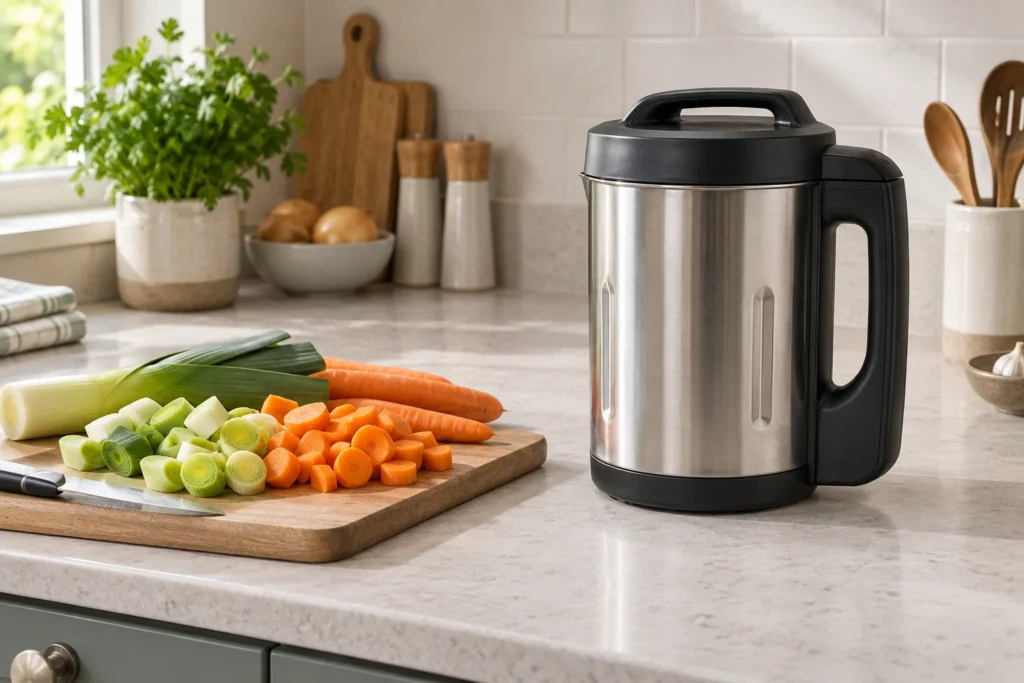
A soup maker that holds plenty can still be a poor choice for one person. The useful capacity is the range between its minimum and maximum fill marks, together with the portion you actually eat. Start with that range before comparing a claim such as “serves four”.
Image: AI-generated editorial illustration of generic equipment; not a photograph of a reviewed product.
Table of Contents
Find the working range, not just the jug size
Look for two numbers in the instruction manual: the minimum mixture required for a soup programme and the maximum permitted mixture. Both count the vegetables and stock together. A litre of stock plus a bowl of vegetables is not a one-litre batch.
Salter’s EK5118 manual specifies a total mixture of 1,300–1,600ml. That is a fairly narrow operating range; a single 350ml lunch does not meet its minimum. The Morphy Richards 501014 recipe guidance likewise identifies a 1.3–1.6L recipe range. These are examples for those models, not standard limits for every soup maker.
For a concrete recipe example, see our pumpkin soup in a soup maker guide. Compare the complete documented batch with the appliance’s working range rather than dividing quantities solely to match the number of bowls you want.
Measure your own serving once
Pour water into your normal soup bowl to the level you would serve, then measure it in a kitchen jug. A small starter and a main-course bowl need different amounts. Record the number rather than relying on a manufacturer’s undefined serving.
For planning, four 350ml bowls require 1,400ml. Two 450ml bowls require 900ml, which would fall below the example 1,300ml minimum. Those calculations do not authorise a recipe: they reveal whether the appliance matches the meal you want to make.
| Your meal plan | Illustrative amount | What to check |
|---|---|---|
| One 350ml lunch | 350ml | Is a genuinely small batch allowed? |
| Four 350ml bowls | 1,400ml | Does the complete recipe fit the soup limits? |
| Two 450ml main portions | 900ml | Would you have to make and store extra? |
| Six 300ml starters | 1,800ml | Would this require separate batches? |
Do not solve a mismatch by ignoring a fill mark
Filling below MIN to avoid leftovers changes the conditions the appliance was designed to use. Filling above MAX to fit one extra bowl leaves insufficient working space. Neither is a sensible way to make a bigger machine behave like a smaller one, or vice versa.
Adding extra stock solely to reach MIN also changes the recipe. You may end up with enough volume but soup that is too thin. Use a properly scaled recipe within the permitted range, or choose an appliance with a suitable small-batch programme. Check what that programme actually permits rather than assuming every portion selector changes the minimum. Compare the fill instructions with the smooth or chunky programme you intend to use.
For another model-specific comparison, see Tefal Easy Soup versus Morphy Richards Total Control. Read the permitted quantities for the programme you intend to use, then compare them with your usual batch rather than relying on the advertised jug size.
Think about the soup after cooking
A batch that supplies tomorrow’s lunch can be convenient if you have a clear plan for safe cooling and storage. Check the container space before treating extra capacity as an advantage. Account for a busy fridge and the fact that four individual portions occupy a different shape from one jug.
If you want several different soups, a large minimum can be more restrictive than a smaller maximum. Making two flavours for two people may create twice the leftovers. Conversely, a household that all eats the same soup together may value one larger batch more than a collection of programmes.
Check the physical jug as well
Compare the filled handling task, lid removal and pouring height. An empty jug that feels manageable in a shop may be less convenient with hot soup inside. Check the handle and spout with the appliance cold; leave appropriate clearance from cupboards during operation as its instructions require.
When using our soup-maker selection guide, write the working range next to each candidate. Then add your bowl size, expected portions and leftover plan. A model that suits those three facts is a more useful shortlist entry than one selected by litres alone.
For a small household, compare the minimum permitted batch with the amount you normally serve. If two bowls leave another full serving, decide in advance whether that suits your meal plan. The useful capacity is the batch you can make correctly and use sensibly, not simply the smallest number in the product range.