
Affiliate disclosure: As an Amazon Associate, we earn from qualifying purchases. Amazon UK links below are affiliate links. Links labelled “Search” open results that may include other models, accessories and sellers. Check the exact model, UK electrical specification, seller, delivered price and availability before buying. Manufacturer links are sources. How affiliate links work.
The best rice cooker for your kitchen starts with the amount of dry rice you normally cook. A basic switch-operated model may be enough for an occasional rice side dish. If you regularly cook small batches or switch between white and brown rice, minimum quantities and dedicated programmes deserve more attention than a long feature list.
This is a researched comparison of three UK-market options, based on manufacturer pages, instructions and support information. We have not tested their rice texture, cooking speed or long-term durability. Our recommendations explain which documented features suit which needs; they are not scored performance rankings.
Already have a cooker, or want to understand the daily routine before buying? Our beginner’s guide to using a rice cooker walks through measuring, choosing the programme and finishing a batch with the model’s instructions.
Table of Contents
Three rice cookers to compare
On a small screen, swipe or scroll the table to see all columns.
| Model and reason to shortlist | Capacity to compare | Main trade-off |
|---|---|---|
| Russell Hobbs 27030 Basic budget option |
Advertised for up to six cooked servings of up to 145g each | Simple cooking switch; no separate brown-rice programme or delayed-finish timer |
| Yum Asia Panda YUM-EN06 Small batches with programme choice |
Up to 3.5 cups of uncooked white rice; manufacturer supports half-cup batches | Smaller batch ceiling; inner bowl and lid need handwashing |
| Yum Asia Kumo YUM-EY10 Larger everyday batches |
Up to 5.5 cups of uncooked white rice; manufacturer supports one-cup batches | Inner lid stays attached for cleaning; brown-rice capacity is lower |
For Panda and Kumo, a full supplied rice cup is 180ml. Their maximum capacities refer to uncooked rice. The Russell Hobbs serving claim describes the finished food, so it cannot be compared directly with the other two numbers. Our rice-cooker cups and capacity guide explains how to compare the measures.
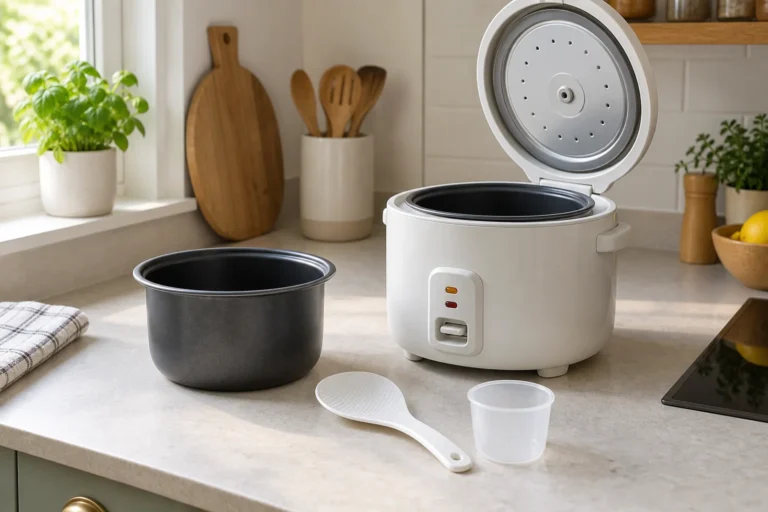
Russell Hobbs 27030: a straightforward budget shortlist
The Medium Rice Cooker and Steamer 27030 is worth checking when you want simple controls and a lower-cost starting point. Russell Hobbs specifies automatic keep-warm and a removable non-stick bowl and glass lid that can go in the dishwasher. Its manual also describes the supplied steaming basket.
Why choose it: the cook/keep-warm switch avoids navigating a programme menu, and the removable parts make the cleaning requirements clear.
What you give up: the controls do not provide separate rice-type programmes or a delayed-finish timer. The instructions acknowledge that a layer of rice can form a crust on the base; we have not measured how often this happens. If you want a precisely documented half-cup batch, the manufacturer’s six-serving headline does not answer that question.
Sources: Russell Hobbs 27030 specifications and 27030 instructions.
Yum Asia Panda YUM-EN06: small portions with more control
Panda is the most relevant option here if your usual batch is small. Yum Asia explicitly supports cooking half a supplied cup of dry rice. The YUM-EN06 model family offers long-grain white, short-grain white, brown and quick-cook programmes, alongside a preset timer. Its bowl is ceramic-coated, rather than a solid ceramic pot.
Why choose it: the documented small-batch option makes it easier to plan a fresh meal without buying around a large maximum capacity. Its removable inner lid, steam cap and condensation collector give access to parts that need routine cleaning.
What you give up: the manual limits brown rice to 2.5 uncooked cups, below the 3.5-cup white-rice limit. It also prohibits putting the inner bowl and inner lid in a dishwasher. Check the colour suffix and UK version when comparing listings; a similar product name does not establish the same electrical specification.
Sources: Panda UK product information, Panda small-batch guidance and Panda YUM-EN06 instructions.
Yum Asia Kumo YUM-EY10: more capacity for regular rice meals
Compare Kumo when Panda’s maximum batch would be restrictive. Yum Asia states a maximum of 5.5 uncooked cups for white rice and four for brown rice, with support for a one-cup batch. The cooker uses fuzzy-logic programmes and a ceramic-coated inner bowl.
Why choose it: it provides more room for your usual dry-rice quantity while retaining the option to cook a smaller batch. This is a capacity-led recommendation; we have not established that its finished rice is better than Panda’s.
What you give up: the stainless-steel inner lid is not detachable, unlike Panda’s. Think about whether you prefer removing a lid for washing or cleaning it in place. The extra capacity is useful only if your normal meals require it; it is not a reason to cook more rice than you need.
Sources: Kumo UK product information, Kumo capacity explanation and Kumo small-batch guidance.
How to choose a budget rice cooker
Start by deciding what problem you want the appliance to solve. If it is simply freeing a hob ring while rice cooks, compare the 27030’s current delivered cost with other basic models of a suitable size. If you regularly need half-cup batches, a brown-rice setting or a ready-at-time function, compare those requirements before choosing the cheapest listing.
A higher price is not evidence of better texture. Equally, a cheap cooker that encourages oversized batches or lacks a function you will use may be poor value for your routine. Include the replacement bowl’s availability and cost in your comparison, and read the warranty and returns terms for the seller you choose.
We have not printed fixed price bands or a “best deal” badge because offers change. The three model-search links are starting points for checking a matching UK product, not a promise that the first result is the right cooker or the lowest price.
Choose capacity from your normal meal
- Record your usual dry-rice quantity. Use a meal you already make, rather than a generic “serves four” promise. Side portions and rice-centred meals can require different amounts.
- Compare like-for-like measures. For the two Yum Asia models, 3.5 × 180ml is 630ml of uncooked rice and 5.5 × 180ml is 990ml. These calculations describe the rice measure, not the bowl’s total liquid volume or a universal weight in grams.
- Check the minimum as well as the maximum. Half-cup support is particularly relevant when buying for one. For brown rice, use its separate limit and water guidance.
- Plan where the cooker will work. Allow space to open the lid, remove the bowl and keep the steam path clear according to the manual. A cooker that fits inside a cupboard may still need to be moved out to operate.
If you want vegetables alongside the rice, check how the basket affects the usable space and the permitted batch. Our rice-cooker steamer-basket guide explains the questions to ask.
Which features are worth paying for?
Rice programmes: a named brown- or short-grain setting gives you a documented starting point for that rice type. Fuzzy logic controls parts of the cooking cycle, but does not remove the need to measure the rice and water correctly. See our fuzzy-logic versus basic rice-cooker comparison.
Cleaning access: compare the removable lid, vent, condensation collector and bowl-care instructions. “Ceramic-coated” still describes a coating that needs appropriate utensils and cleaning. Our rice-cooker pot-material guide separates material choice from care requirements.
Keep-warm and timers: choose these around when you actually eat, and follow the exact model’s food and timing restrictions. A keep-warm button is not a general storage plan for leftovers. Read the keep-warm and storage guide before planning long holds or delayed meals.
Questions before buying
Does a six-serving cooker take six cups of dry rice?
No. A serving of cooked food and a measuring cup of uncooked grain are different units. For the 27030, the manufacturer expresses the headline capacity as cooked portions. Use the instructions and bowl markings for the appliance you receive; do not turn that serving claim into a six-cup dry-rice allowance.
Can I use one water ratio for every rice cooker?
Use your model’s instructions for the rice type, quantity and programme. For example, Panda provides separate half-cup guidance because that quantity has no bowl line. A generic ratio can miss those details. If the cooker is overflowing, work through our fill, preparation and vent checks rather than repeatedly adding more water.
Can all the removable parts go in the dishwasher?
No. The 27030’s manufacturer permits its bowl and glass lid, while Panda’s instructions require the inner bowl and inner lid to be washed by hand. Check every component separately. Our rice-cooker cleaning guide covers the different parts.
Which one should you shortlist?
Choose the Russell Hobbs 27030 for a simple budget comparison, the Panda YUM-EN06 when a documented half-cup batch and rice programmes matter, or the Kumo YUM-EY10 when you need a larger regular batch. Match that choice to your normal meal, cleaning preferences and the current offer for the exact UK model.